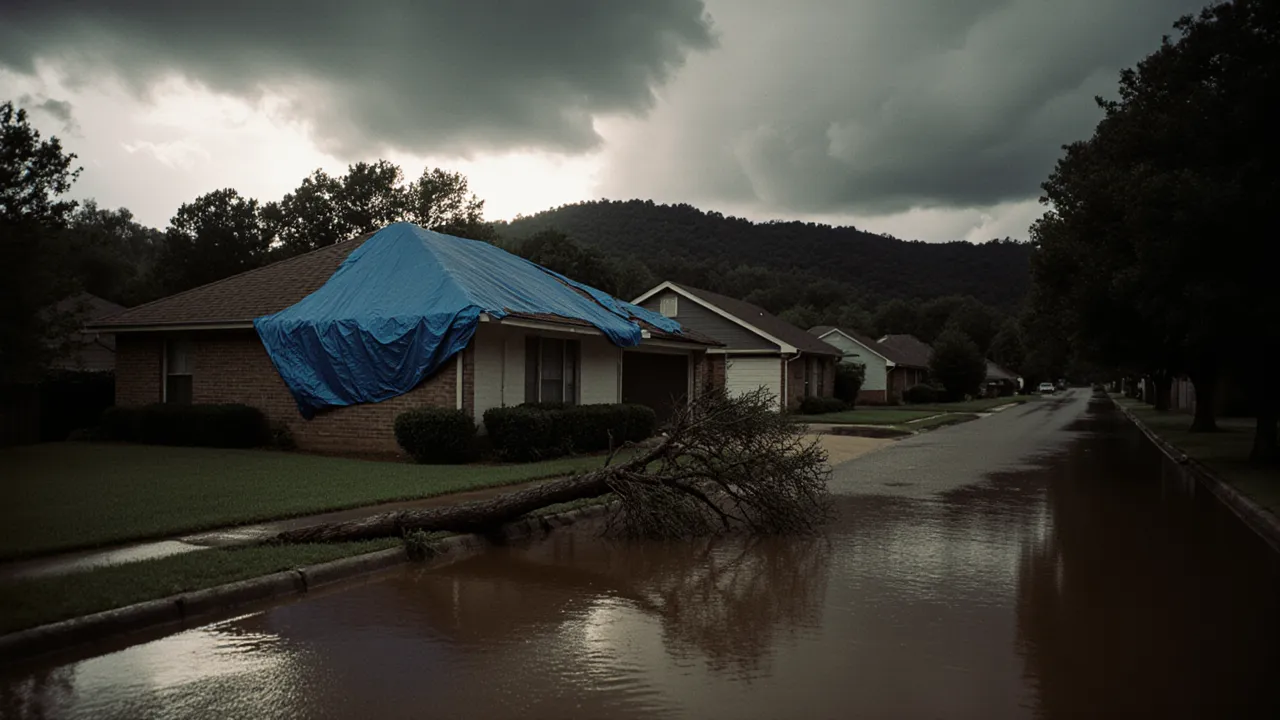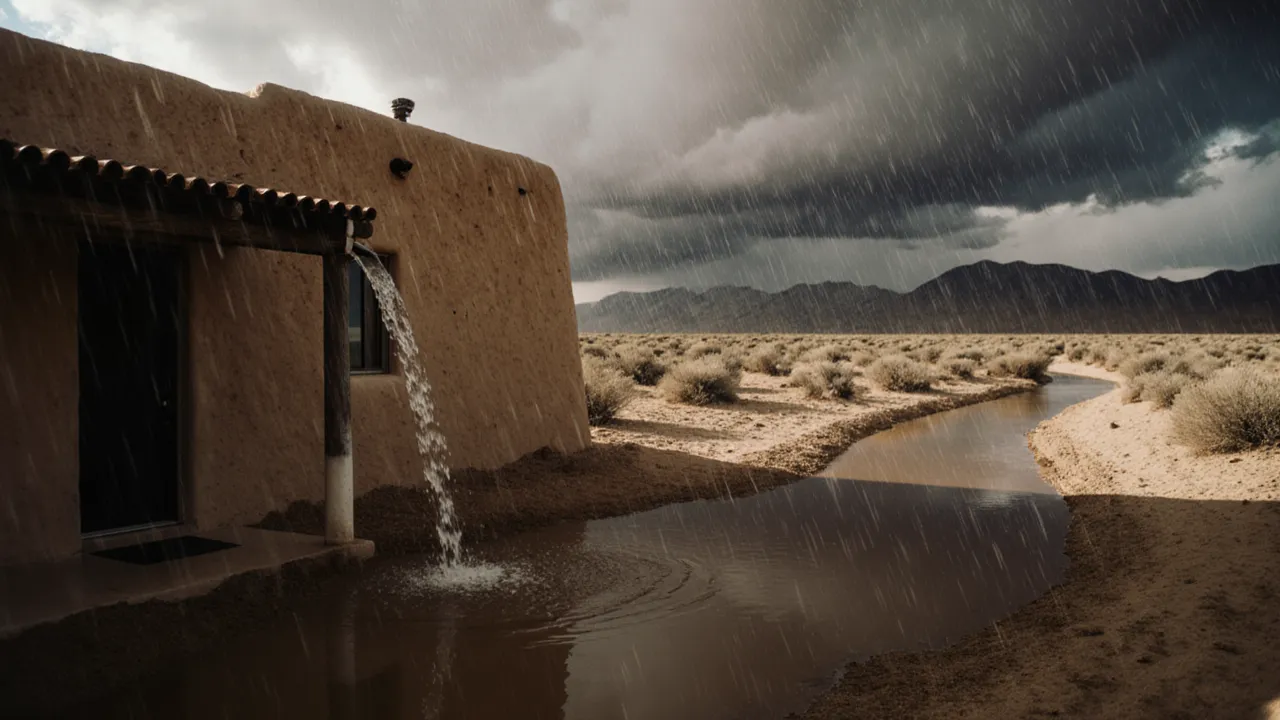
Las Cruces gets around nine inches of rain in a typical year, and a good share of it can arrive in a handful of July and August afternoons. That is the whole problem in one sentence. The North American Monsoon does not deliver water gently; it delivers it in short, violent bursts onto ground that has been baked hard for months, in a valley shaped by arroyos that exist specifically to carry that water somewhere else in a hurry.
Homeowners here are often surprised that water damage is a serious local risk at all. It is, and it does not look like water damage in a wet climate. This guide covers how monsoon flash flooding, flat roofs and evaporative coolers cause losses in Las Cruces, what to do first, and how New Mexico insurance treats each cause.
Why the Desert Floods
Dry ground does not absorb a downpour; it sheds it. Caliche layers and sun-hardened desert soils across the Mesilla Valley have very low infiltration rates, so an inch of rain in thirty minutes runs off almost entirely. That runoff concentrates in arroyos draining the Organ Mountains and the West Mesa, and an arroyo that has been a dusty walking path all year can carry a fast, debris-laden flow within minutes of a storm that is still miles away.
Several things make Las Cruces losses worse than the rainfall totals imply:
- The rain often falls somewhere else. A storm over the Organs can send water down an arroyo into a neighborhood in bright sunshine. People are caught unprepared because it is not raining where they are.
- Burn scars amplify runoff. After a wildfire in the mountains, the burned ground repels water for years, multiplying both the volume and the sediment load that reaches the valley.
- Development changes the paths. New streets, pads and walls in a growing city redirect historic drainage, and water finds the low spot regardless of where the lot line is.
- Deferred maintenance goes unnoticed. In a climate this dry, a cracked parapet or a failed roof seam can sit unnoticed for years, because nothing tests it until the monsoon does.
Flat Roofs, Parapets and Canales
Southwestern construction is built for sun, not for standing water. Flat and low-slope roofs drain through canales or scuppers cut through a parapet wall, and every one of those is a potential entry point. The common failure modes are specific and worth checking before monsoon season:
- A canale that is blocked or too short, so water sheets down the stucco wall instead of clearing it, saturating the wall assembly and the foundation below.
- Cracked or failed roof coating and seams, which in dry heat degrade steadily and invisibly.
- Parapet cap flashing that has opened at the joints, letting water into the top of the wall where it travels down inside the assembly.
- Ponding on a low-slope roof after a hard rain, which pushes water uphill under laps.
- Stucco cracks at corners and window returns that wick water into the sheathing.
Roof-driven water in a Las Cruces home usually appears as a stain on a ceiling or the top of a wall days after the storm, once the assembly has held enough water to show it. By then the insulation above is wet and the drying job is much larger than the stain suggests.
The Evaporative Cooler Problem
Swamp coolers are efficient in this climate and they are also one of the most common causes of interior water damage in southern New Mexico. Most are mounted on the roof or at a window, they are connected to a water supply line, and they run for months without anyone looking at them.
The failure modes are a stuck float valve overflowing the pan, a corroded pan that rusts through, a supply line that splits, or a unit that was never properly drained and winterized. Because the unit sits above the ceiling, the water goes into the ceiling cavity, the insulation and the wall below it, often overnight, and often while the family is asleep or away. Inspect the pan and float at the start of cooling season, replace the supply line on a schedule, and shut off and drain the unit properly in fall.
Your First 60 Minutes
- Stay out of moving water, in the street or the arroyo. Flash flood flow in this region carries rock and debris and is far stronger than it looks.
- Shut off the water source if it is a cooler or a supply line, and cut power to wet areas at the breaker.
- Treat arroyo water as contaminated. It carries sediment, animal waste and whatever the wash collected.
- Photograph everything before moving it, including exterior mud lines showing how high the water rose.
- Relieve trapped water in a bulging ceiling carefully from a safe position, or wait for the crew; a sagging saturated ceiling can come down all at once.
- Call for extraction the same day. Low humidity outside does not dry a wet wall cavity from the inside.
Drying and the Hidden Mold Risk
The most misleading thing about water damage in a desert climate is that surfaces dry quickly while the assembly behind them does not. Stucco, adobe, plaster and masonry hold moisture for a long time, and a wall that feels dry on both faces can be saturated in the middle. That is why professional work here relies on meters and, where useful, thermal imaging rather than appearance.
A crew working to the IICRC S500 standard extracts standing water, removes saturated insulation and unsalvageable porous materials, opens assemblies where needed so cavities can be dried and inspected, and runs air movers and dehumidifiers with logged daily readings until documented dry standards are met. Flood and arroyo water is handled as contaminated, with containment and antimicrobial treatment.
Mold absolutely occurs in New Mexico. It grows in the wet cavity, not in the dry room air, and it can begin within 24 to 48 hours of the material getting wet. Because homeowners here reasonably assume the desert will dry things out, hidden growth in a ceiling or wall assembly is often found months later during a remodel. Mold remediation under IICRC S520 means containment, HEPA filtration, removal of affected porous materials and fixing the moisture source.
Prevention Before Monsoon Season
- Inspect and recoat the roof on a schedule, and check every seam, parapet cap and penetration in June.
- Clear and extend canales and scuppers so discharge lands clear of the wall and foundation.
- Grade the lot away from the house and keep gravel and landscape berms from channeling water toward the slab.
- Know your arroyo. Understand where water goes on your street during a hard rain, and keep the path clear rather than walled off.
- Service the evaporative cooler at startup and shutdown, and replace aging supply lines.
- Seal stucco cracks at corners and window returns before the rains.
- Consider flood insurance even outside a mapped zone; arroyo flooding routinely affects property that is not in a high-risk area.
Insurance in New Mexico
A standard New Mexico homeowners policy generally covers sudden and accidental discharge from inside the home, which includes a failed evaporative cooler supply line or an overflowing pan, and wind-driven rain entering through a storm-created opening. It does not cover rising surface water. Arroyo and flash flooding, mud and debris flow, and water sheeting across the property are excluded and require separate NFIP or private flood insurance.
Two local nuances matter. Gradual leakage from a long-neglected roof is commonly denied as a maintenance issue rather than a sudden loss, which makes documented roof maintenance genuinely valuable. And after a wildfire, burn-scar flooding and debris flow are treated as flood rather than fire, so the fire claim and the water claim are not the same claim. We document the source and category of the water precisely so the right policy responds, and bill carriers directly. See our insurance guide for detail.
What Drives the Cost of a Las Cruces Restoration
Homeowners usually want a number before they want a process, and the honest answer is that the scope, not the square footage, sets the cost. A few factors move it more than anything else.
Water category is the largest single driver. Clean water from a supply line can often be dried in place. Arroyo and monsoon runoff is contaminated, which means containment, protective equipment, removal of porous materials and antimicrobial treatment rather than drying alone.
Time to response is the second. The same loss caught in two hours and caught in two days are different jobs, because the water keeps moving into materials the entire time. This is why we do not ask people to wait for an adjuster before drying starts.
Construction type matters in the Southwest more than most places. Stucco, plaster, adobe and masonry hold water far longer than frame and drywall, so drying takes longer and requires more monitoring.
Concealed spread is the wildcard. Water that entered at the roof and traveled inside a wall assembly can affect several rooms while showing a single stain, and the true scope is only known after a proper moisture map.
What you control is the response time and the documentation. Both reduce the final number, and both are free.
Frequently Asked Questions
Does homeowners insurance cover monsoon flash flooding in Las Cruces?
No. Runoff and arroyo flooding is rising surface water, which standard homeowners policies exclude. It requires separate NFIP or private flood insurance. Roof leaks from a storm-created opening and sudden internal leaks are generally covered.
Can mold really grow in a climate this dry?
Yes. Mold grows where the material is wet, and a wall or ceiling cavity that took on water stays wet long after the room air feels dry. Growth can begin within 24 to 48 hours. Low outdoor humidity does not dry an enclosed assembly.
My swamp cooler leaked into the ceiling. Is that covered?
A sudden failure such as a split supply line or an overflowing pan is typically treated as sudden accidental discharge and covered. A unit that has been slowly leaking for months is more likely to be denied as gradual damage, which is why the date of discovery and documentation matter.
The stain is small. Do I really need a crew?
Usually yes. In stucco, plaster and masonry construction the visible stain is a small fraction of the wet area, and insulation above a ceiling holds water for a long time. A moisture reading takes minutes and tells you whether it is a paint problem or a drying job.
How fast can a crew reach my Las Cruces home?
We dispatch 24 hours a day and crews serve Las Cruces and the Mesilla Valley. Arrival depends on your location and current demand, which climbs sharply during a monsoon event affecting many properties at once.
Get Help Now in Las Cruces
Water damage in Las Cruces does not pause overnight or wait for business hours. Call our 24/7 dispatch line at (888) 502-0998 and we will get an IICRC-certified crew moving toward your property and coordinate directly with your insurance carrier.