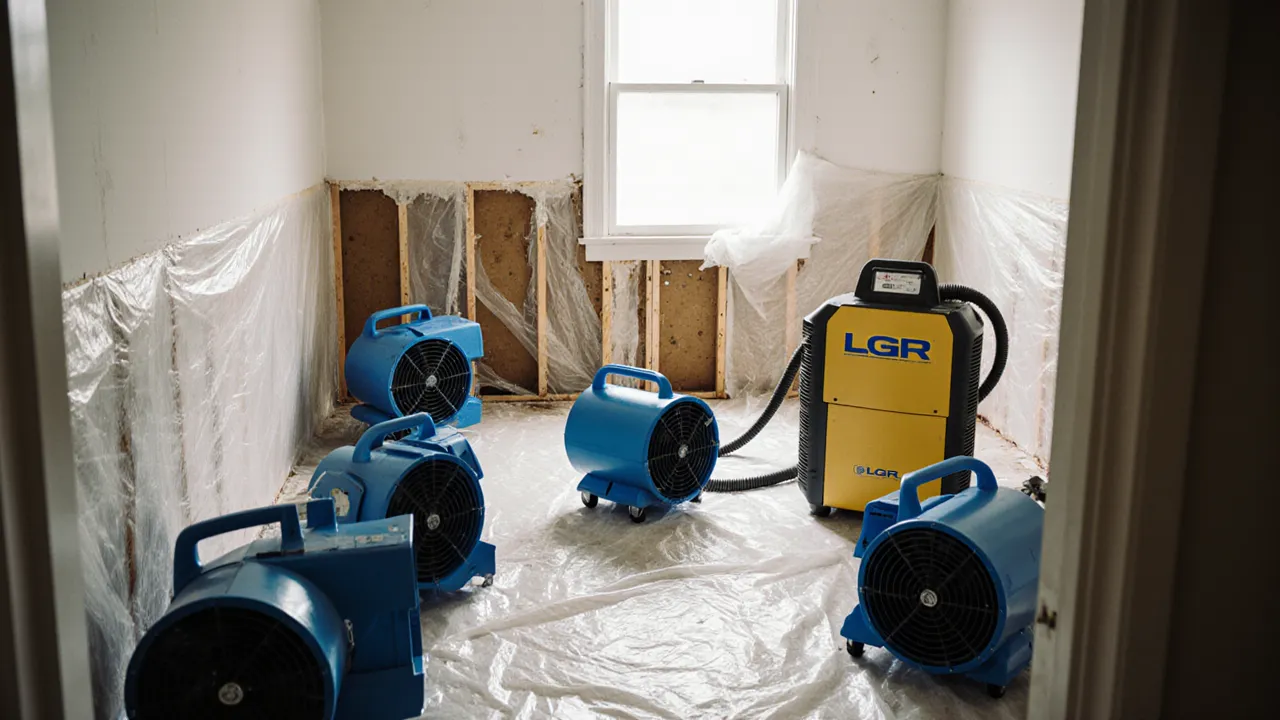
Every IICRC-certified water damage restoration crew watches the same number: 72 hours. It is the threshold between a job that closes with drying alone and a job that becomes a mold remediation project. The threshold matters for cost, scope, timeline, and insurance treatment.
Here is why structural drying speed determines so much, and what the threshold actually means.
The biology, simplified
Mold spores are in your house right now. Normal indoor concentrations are harmless. The spores become a problem only when they find sustained moisture (porous material above ~20% moisture content) combined with food (cellulose: drywall paper, wood, cotton, cardboard).
Given those two conditions, most molds begin germinating within 24–48 hours. By 72 hours, visible colonies are usually established. By a week, the colony has produced its own spores and is reproducing.
This is why drying must begin in the first 24 hours and must bring materials below 16% moisture content before 72 hours. Hit the window, prevent mold growth entirely. Miss it, and the scope expands.
What “structural drying” means in practice
Structural drying refers to drying the framing and built-in materials of the property: studs, plates, joists, subfloors, drywall, insulation, hardwood, tile substrate. Surface drying (carpet, contents, visible items) is the easier part. The challenge is the materials inside wall cavities, under flooring, and behind cabinetry — spaces ambient air does not reach.
Crews accomplish structural drying with:
- Air movers — high-velocity fans (typically 2,500–3,400 CFM) that move air across affected surfaces to accelerate evaporation
- Dehumidifiers — commercial units sized in pints-per-day capacity, matched to the cubic footage and humidity load
- Drying chambers when wall cavities are involved — pressurized airflow injected into the cavity through small holes drilled at the base
- Floor mat systems for hardwood — sealed mats placed on the floor surface with negative pressure pulling water out from below
- Heat at strategic phases — warm dry air holds more moisture than cool air, accelerating evaporation
Equipment runs continuously, usually 3–7 days depending on saturation, material types, and ambient conditions.
The verification process
Drying is not done when crews think it looks dry. It is done when moisture meters confirm every affected material has reached its dry standard, which varies by material:
- Drywall: below 16% moisture content (pinless meter)
- Wood framing: below 14% moisture content (pin meter)
- Concrete: below 4 lbs per 1,000 sq ft per 24 hours (calcium chloride or in-situ probe)
- Hardwood floors: within 2–4 percentage points of unaffected baseline
Readings are logged daily across multiple points. Drying is verified, not estimated. The drying log is part of the insurance documentation; carriers expect to see it.
Why ambient conditions change the math
The same loss dries faster in some climates than others. In hot, dry conditions — Phoenix, Denver in summer, the desert Southwest — air movers alone can dry materials within 3–5 days. Ambient air pulls moisture out naturally.
Need help right now?
Live dispatcher 24/7. IICRC-certified crews. Direct insurance billing.
Call (888) 502-0998In humid Pacific Northwest conditions — Seattle, Portland in winter — drying takes 30–50% longer. Ambient humidity is high, so dehumidifiers do most of the work. We size dehumidification heavily and run longer.
In humid Southeast summer conditions — Atlanta, Orlando, Memphis — both heat and humidity are high. We use a combination of dehumidification and controlled heat, and we treat the mold growth window as 18–36 hours rather than the standard 24–48.
Costs of missing the 72-hour window
Suppose a customer calls within hours and gets a crew on site Day 1. Drying runs Day 1 to Day 5. Materials reach dry standard. Reconstruction is minor (replacing baseboards, touching up paint). Total: 1–2 weeks, modest cost, scope stays within the original estimate.
Now suppose the customer waits five days hoping the loss dries on its own. By the time crews arrive, mold growth has begun. The scope now requires: containment construction, removal of mold-affected materials, antimicrobial application, HEPA filtration, verified clearance, full reconstruction of removed materials, possibly third-party clearance testing. Total: 4–8 weeks, 2–4x the cost, and the carrier may push back on coverage of the mold-related expansion.
The 72-hour window is the practical threshold between these two scenarios.
What homeowners can do
- Call (888) 502-0998 the moment you notice damage — do not wait to assess severity
- Document with photos before moving anything
- Stop the water source if you safely can
- Begin extraction with what you have if a crew is more than an hour away (rugs out, fans on if the water is clean)
- Do not turn on HVAC over the affected area if water reached registers
- Stay out of standing water until power is confirmed off
FAQ
How do crews monitor drying progress?
Daily site visits with moisture meters, recorded on a drying log. Equipment is repositioned based on readings. Drying is declared complete only when materials reach dry standard at every documented point.
Can drying equipment be left running unattended?
Yes, and it usually is. Equipment runs 24/7 throughout the drying phase. Crews return daily for readings and adjustments. Power consumption is significant; this is part of the documented scope.
What if drying is not making progress?
Sometimes a hidden water source continues to add moisture (an unfixed slab leak, an ongoing roof leak). Crews investigate and resolve the source before drying can succeed. Comprehensive restoration includes finding and stopping the source.
Do you handle structural drying in PNW winters?
Yes. Water removal and structural drying in Seattle and Portland account for our most common winter call volume. We size equipment for the climate and verify dry standards with extra readings.
Call (888) 502-0998 24/7 for fast drying dispatch.
People also ask
How fast can a crew reach my address?
Typical metro dispatch is 30 to 75 minutes off-peak. Severe-weather events extend windows; we pre-stage crews when major storms are forecast.
Do you bill insurance directly?
Yes. We bill homeowners and commercial property carriers directly using Xactimate-compatible scopes plus moisture maps, photos, and IICRC S500/S520 documentation.
Will my homeowners policy cover this?
Sudden-and-accidental water damage from covered perils is usually covered. Rising-water flooding requires a separate flood policy. Long-term seepage is typically excluded as maintenance.
What is a Category 3 water loss?
Cat 3 is contaminated water (sewage backups, storm surge, combined sewer overflow). It requires containment, EPA-registered antimicrobials, and verified clearance before reconstruction.