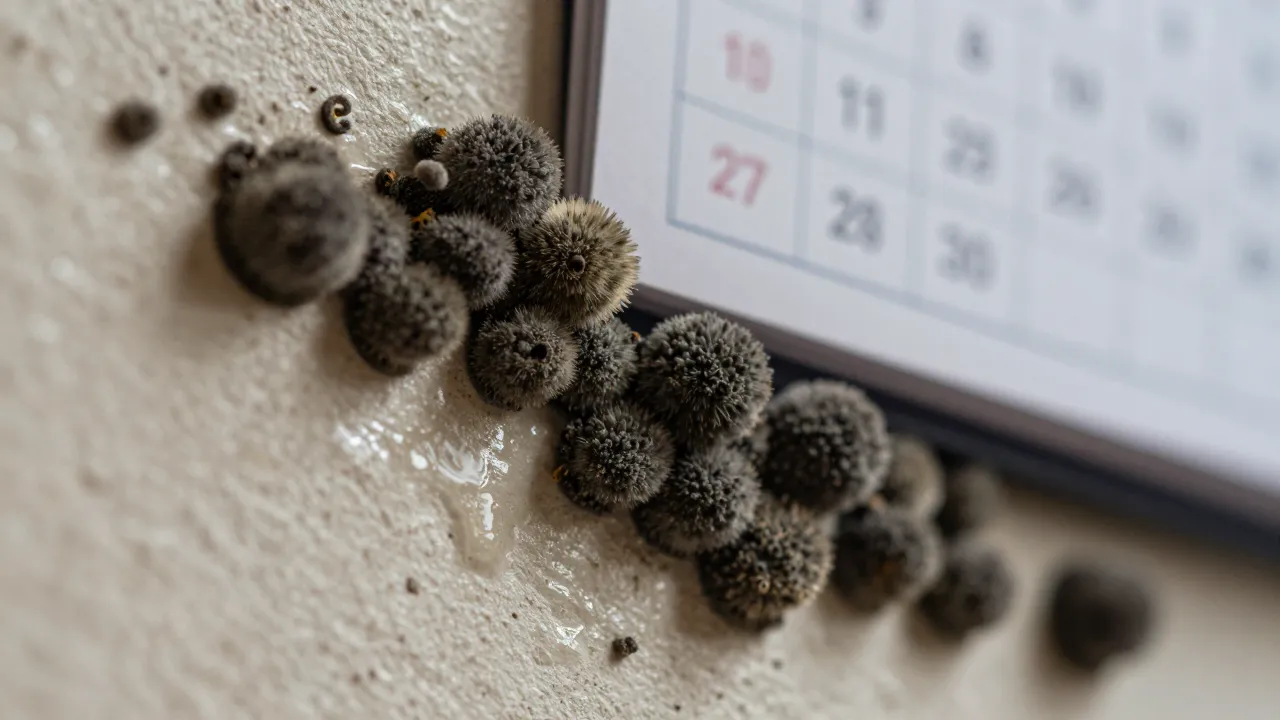
The single most-asked question after a water loss: how fast does mold grow? The honest answer is faster than most people expect, and the timeline is the reason restoration crews rush.
Mold spores exist everywhere — in your house right now, in normal concentrations they are harmless. They become a problem only when they find sustained moisture and food (drywall paper, wood, cardboard, insulation, fabric, dust). After a water loss, both conditions become abundant. Growth follows.
The 24–48 hour window
The CDC and EPA both put the window for mold growth on wet building materials at 24 to 48 hours after sustained wetting. IICRC S500 (the water damage standard) uses the same window. ANSI/IICRC S520 (the mold remediation standard) defines a Condition 2 (settled spores) or Condition 3 (active growth) within that window if drying does not begin.
What this means in practice: a wall cavity that gets saturated Monday morning and stays wet until Wednesday afternoon will likely have visible mold colonies starting on Tuesday night or Wednesday morning. By the time you smell musty odor, the colony has been growing for days.
The species we see most often
Three genera account for the majority of post-water-damage mold our mold remediation crews encounter:
- Cladosporium — olive-green to brown colonies on drywall, wood, and fabric. Common, generally less hazardous than Stachybotrys but still requires removal.
- Penicillium / Aspergillus — the most-frequently-identified group on water-damaged materials. Blue-green or yellow colonies. Some species produce mycotoxins.
- Stachybotrys chartarum (black mold) — the species most people fear. Requires sustained wetness (typically 7+ days) and high cellulose content (paper-faced drywall, wood). Less common than Penicillium/Aspergillus but more health-impacting.
Identifying the species matters for the remediation protocol, not for the urgency. Any colony triggers the same response: containment, HEPA filtration, removal, antimicrobial application, verified clearance.
Why drying speed matters more than anything else
If a crew is on site within the first 24 hours and gets drying equipment running, mold growth is usually prevented entirely. The materials dry below 16% moisture content within 3–5 days, the spores never find sustained moisture, and the loss closes without a mold remediation phase.
If 48–72 hours pass before drying begins, mold growth is likely. The remediation scope expands by 30–60% in cost and timeline because affected materials must now be contained, removed, and replaced rather than dried in place. Water damage restoration jobs that catch the loss quickly close in 2–3 weeks; jobs that delay turn into 6–10 week projects.
Climate amplifies the timeline
Ambient humidity changes the math. In humid climates like Tampa, Miami, and Houston, mold growth runs faster — we treat the window as 18–36 hours rather than 24–48. In drier climates like Phoenix, Denver, and the high desert, the window stretches to 36–60 hours because ambient air pulls moisture out of materials naturally.
This is why our dispatcher asks climate-specific questions during the call. The same loss in Tampa and in Phoenix calls for different drying capacity and different urgency.
Need help right now?
Live dispatcher 24/7. IICRC-certified crews. Direct insurance billing.
Call (888) 502-0998What insurance carriers expect
Carriers know the 24–48 hour window. They expect homeowners to mitigate within it. Documentation that shows you called for dispatch within hours of discovering the loss strengthens your claim significantly. Documentation that shows the loss sat for a week before anyone responded weakens it — carriers can argue that mold-related expansion of the scope is attributable to delay, not the original loss.
This is one of the strongest practical reasons to call (888) 502-0998 the moment you notice damage, even before opening the claim. Time-stamped photos and a logged dispatch request establish the timeline that protects coverage.
Hidden mold — what you cannot see
Most post-water-loss mold growth happens inside wall cavities, under floors, behind baseboards, and inside HVAC ducts — places that stay damp longest and that you cannot inspect without removal. Surface mold on visible drywall is often the smaller portion of total growth.
This is why moisture mapping with pin and pinless meters is part of every IICRC S500 scope. Dry standards are verified at the materials level, not by visual inspection.
FAQ
Can mold grow in drywall after just one day?
Yes. Drywall paper is paper, and paper that has been wet for 24 hours under normal indoor conditions is at the front end of the mold growth window. Visible colonies usually appear at 48–72 hours.
Does running a fan prevent mold?
Air movement alone does not dry materials enough fast enough. You need dehumidification combined with air movement, sized to the affected cubic footage. A household fan moves humid air around the room without removing the moisture.
How do I know if I have hidden mold?
Persistent musty odor, discolored drywall, soft or warped flooring, respiratory symptoms that improve when you leave the house. A moisture meter reading on a suspect wall will tell you if elevated moisture is still present. Visible mold is confirmation.
Is bleach a substitute for professional remediation?
For surface mold on a non-porous material (tile, glass, sealed concrete), bleach can be effective. For mold on porous materials (drywall, wood, fabric), bleach kills surface mold but cannot reach the colony rooted inside the material. The affected portion must be removed and replaced.
Call (888) 502-0998 if you suspect post-water-damage mold growth.
People also ask
How fast can a crew reach my address?
Typical metro dispatch is 30 to 75 minutes off-peak. Severe-weather events extend windows; we pre-stage crews when major storms are forecast.
Do you bill insurance directly?
Yes. We bill homeowners and commercial property carriers directly using Xactimate-compatible scopes plus moisture maps, photos, and IICRC S500/S520 documentation.
Will my homeowners policy cover this?
Sudden-and-accidental water damage from covered perils is usually covered. Rising-water flooding requires a separate flood policy. Long-term seepage is typically excluded as maintenance.
What is a Category 3 water loss?
Cat 3 is contaminated water (sewage backups, storm surge, combined sewer overflow). It requires containment, EPA-registered antimicrobials, and verified clearance before reconstruction.