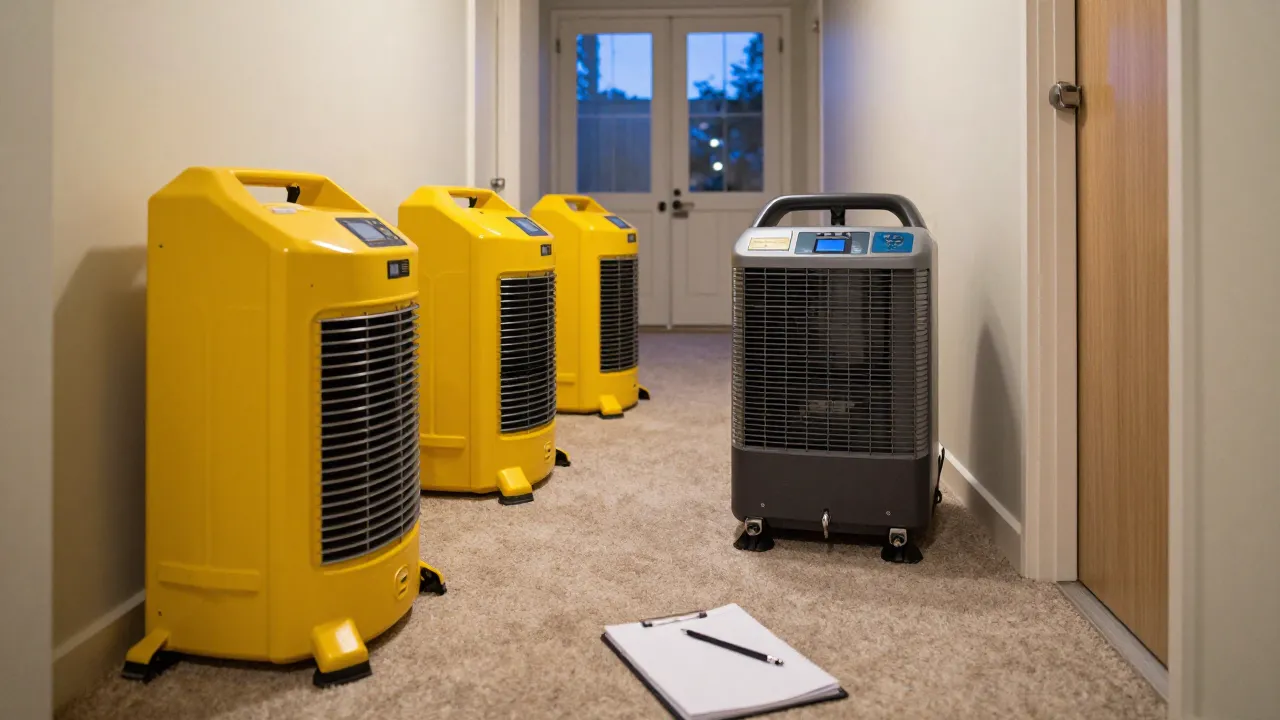
The first 24 hours after a water loss is the difference between a mitigation job and a structural rebuild. Mold growth starts inside 24–48 hours. Drywall and subfloor begin permanent damage within 8–12 hours of saturation. Your insurance carrier expects documented action from the moment you notice the damage.
Here is the action list we walk customers through when they call our dispatcher, in priority order.
Step 1 — Stop the source (0–15 minutes)
If a supply line is the cause, shut off the main water valve to the building. It is usually in the basement, garage, utility closet, or near the water meter. For a fixture failure (toilet, sink, washer hose), close the local angle stop under the fixture. For roof leaks during active rain there is no shutoff — move to step 2 immediately.
If the loss involves sewage or storm water, do not enter standing water until you confirm the electrical panel is off. Sewage-contaminated water is Category 3 and carries serious health risks.
Step 2 — Document everything (15–45 minutes)
Take photos of every affected room from multiple angles before you move anything. Photograph water lines on walls, soaked materials, damaged contents, and the source of the leak if visible. Your adjuster will require this documentation. Photos taken after cleanup are worth a fraction of photos taken at peak damage.
Note the time water started entering, the suspected source, and any safety hazards. If sewage or contaminated water is involved, mark which rooms it reached — that drives the scope-of-work documentation later.
Step 3 — Call for dispatch (45–60 minutes)
Call (888) 502-0998 and give the dispatcher: your address, the loss type (clean water from supply line, gray water from washer, black water from sewage, storm/flood), affected rooms, and any safety concerns (active leak, electrical risk, sewage). A crew is dispatched immediately — typical arrival is 30–75 minutes depending on city. LA, Houston, and Miami all have inside-the-loop response under an hour.
Step 4 — Notify your insurance carrier (1–3 hours)
Open the claim with your insurance carrier as soon as it is safe to do so. You can call us first — mitigation is time-critical and most carriers expect the homeowner to mitigate before they arrive on site. We bill the carrier directly using Xactimate-compatible documentation, but you still need to open the claim under your name.
Have your policy number, the loss type, and the rough time the damage started. If sewage or flooding is involved, ask whether you have the relevant endorsement; a separate flood insurance policy is required for rising-water losses.
Need help right now?
Live dispatcher 24/7. IICRC-certified crews. Direct insurance billing.
Call (888) 502-0998Step 5 — Begin safe self-mitigation (1–6 hours)
While waiting for crews, you can safely: lift area rugs and small furniture off wet flooring; place aluminum foil or plastic under furniture legs to prevent staining; open windows if humidity is lower outside; turn off the HVAC system if water reached supply or return registers (running it spreads moisture and contaminants).
Do not: turn on ceiling fans or HVAC over a Cat 2 or 3 loss; vacuum standing water with a household vacuum; lift wet drywall without containment; enter standing water with shoes you plan to keep wearing.
Step 6 — What happens when crews arrive (4–8 hours)
The dispatched water damage restoration crew arrives with truck-mounted extractors, moisture meters, and IICRC S500 documentation tools. They will: scope the loss with moisture readings, photograph everything, set up containment if Cat 2 or 3, extract standing water with truck-mounted equipment, remove unsalvageable materials per S500 categories, and set initial air movers and dehumidifiers. This is the most time-critical phase — every hour matters before mold growth begins.
What you should NOT do
Do not wait for insurance approval to start mitigation. Carriers expect homeowners to mitigate; failing to mitigate can reduce or void coverage. Do not throw away damaged materials before documentation. Do not run dehumidifiers in a Cat 2 or 3 zone without containment — you spread contaminants. Do not delay the call because you think it is small. Hidden water behind walls or under floors is often worse than what is visible.
FAQ
How fast does mold grow after water damage?
Mold can begin growing on saturated organic materials (drywall paper, wood, cardboard, fabric) within 24–48 hours of the initial wetting. That is why drying must begin in the first 24 hours.
Should I turn off electricity?
If water reached outlets, the electrical panel, or you can see water near energized fixtures, yes — shut off power at the main breaker before entering the room. If the loss is contained to a small area away from electrical, leave power on.
Will my insurance cover this?
Sudden-and-accidental water damage from a burst pipe, appliance failure, or storm-damaged roof is usually covered. Rising-water flooding from a river, creek, or storm surge is excluded under standard homeowners and requires a separate flood policy. Long-term seepage from poor maintenance is typically excluded.
How quickly can a crew arrive?
Typical dispatch is 30–75 minutes in most metro areas. Outer suburbs and rural addresses can be 60–90 minutes. We pre-stage crews when major storms are forecast.
Call (888) 502-0998 24/7 for emergency dispatch.
People also ask
How fast can a crew reach my address?
Typical metro dispatch is 30 to 75 minutes off-peak. Severe-weather events extend windows; we pre-stage crews when major storms are forecast.
Do you bill insurance directly?
Yes. We bill homeowners and commercial property carriers directly using Xactimate-compatible scopes plus moisture maps, photos, and IICRC S500/S520 documentation.
Will my homeowners policy cover this?
Sudden-and-accidental water damage from covered perils is usually covered. Rising-water flooding requires a separate flood policy. Long-term seepage is typically excluded as maintenance.
What is a Category 3 water loss?
Cat 3 is contaminated water (sewage backups, storm surge, combined sewer overflow). It requires containment, EPA-registered antimicrobials, and verified clearance before reconstruction.