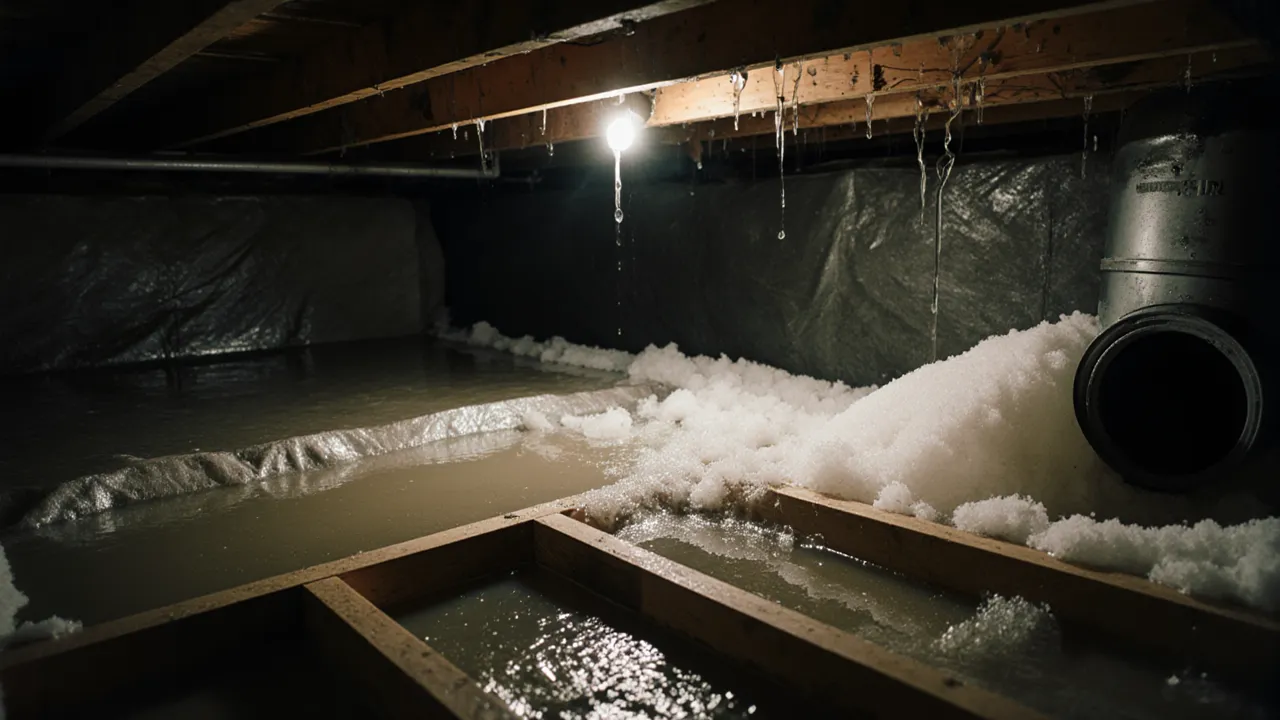
Meridian has grown faster than almost any city in Idaho, and most of what has been built here sits on a crawl space rather than a basement. That single construction choice shapes the water damage picture across the Treasure Valley. A crawl space is a two to four foot void under your floor that nobody enters, nobody inspects, and nobody smells until the moisture has been working on the framing for months. It is also, in this valley, sitting on top of a water table that rises and falls on an irrigation schedule.
This guide covers why Meridian crawl spaces take on water, how to tell from inside the house, what proper drying involves, how freeze events add a second failure path, and what Idaho insurance typically covers.
Why Treasure Valley Crawl Spaces Get Wet
Meridian averages roughly a foot of precipitation a year, which sounds like it should make water damage rare. It does not, because the water that reaches most crawl spaces here is not rain.
The Treasure Valley runs on delivered water. A dense network of canals and laterals fed from the Boise River, including the Ridenbaugh Canal and the Five Mile and Nine Mile drainages, charges the shallow groundwater across the valley from roughly April through October. When the irrigation season starts, the water table under many Meridian subdivisions rises measurably. Homes that were bone dry in February can have standing water under the floor in June without a drop of rain falling. Add pressurized irrigation systems watering lawns on a timer, and a failed sprinkler line or a head aimed at the foundation can pump water against the stem wall for weeks before anyone notices.
The second source is the ground itself. Much of the valley sits on silty loam and caliche layers that perch water rather than letting it drain. Water that gets into the backfill around a foundation sits there. If the crawl space vapor barrier is torn, poorly lapped, or was never installed properly during a fast build, that moisture evaporates directly into the space under your floor.
The third is spring snowmelt off the Boise foothills combined with a rain-on-snow event, which can put more water into local drainage in a few days than the valley normally sees in months.
How to Tell From Inside the House
Because nobody looks in a crawl space, the symptoms show up upstairs first:
- A musty smell that is strongest near floor vents or in a closet on an exterior wall. Crawl space air does not stay in the crawl space; the stack effect pulls a meaningful share of it up into your living space.
- Floors that feel cold, soft or springy in one area, which points to a subfloor that has been damp long enough to lose stiffness.
- Cupping or gapping hardwood over one part of the house.
- Indoor humidity that will not come down in a climate this dry, or condensation on windows in winter.
- Higher heating bills as wet insulation loses its R-value and falls out of the joist bays.
- Rust on ductwork, pipes or foundation hardware visible at the access hatch.
If you can open the access door safely, look for standing water, a vapor barrier floating or displaced, insulation hanging down, or dark staining on the underside of the subfloor. Any of those means the space has been wet for a while.
The Freeze Path: A Second Way Meridian Homes Flood
Idaho winters bring hard freezes, and a vented crawl space in a cold snap is effectively outdoor temperature with plumbing running through it. Supply lines in an unconditioned crawl space, hose bibs, and lines running through exterior stem walls are the usual failure points. A burst line under the floor can run for hours before anyone hears it, because the sound is muffled and the water goes down rather than into the room.
Two habits prevent most of it: close the foundation vents before the first hard freeze and insulate the supply lines and hose bibs, and know where your main shutoff is before you need it in the dark. Our guide to what to do in the first hour of a burst pipe covers the immediate steps.
Your First 60 Minutes
- Shut the water main if the source is a broken supply line, and open a low fixture to relieve pressure.
- Shut off the irrigation system if the water appeared during the watering season and you suspect a line or head near the foundation.
- Cut power to any circuits serving the crawl space before anyone goes in.
- Do not crawl into standing water. Between wiring, rodents and whatever the water carried in, it is not a DIY space once it is flooded.
- Photograph the access hatch view and the affected rooms above before anything is moved or removed.
- Call for extraction the same day. Water under a floor does not evaporate on its own in a closed space; it just keeps the wood above it wet.
What Proper Crawl Space Restoration Involves
Crawl space drying is a different job from drying a room, and it is done badly more often than any other water loss. Standing water is extracted or pumped out first. Saturated fiberglass insulation is removed rather than dried; once it has been wet it holds moisture against the joists and no longer insulates. The vapor barrier is pulled, the soil surface is treated where contamination is involved, and a new barrier is installed and properly lapped and sealed.
Then the structure itself has to be dried. Joists, girders, sill plates and the underside of the subfloor are monitored with meters, and dehumidification is run in the enclosed space until documented dry standards are met. This normally takes longer than an above-grade room because airflow is restricted and the soil below keeps contributing moisture. Where growth has already started on the framing, mold remediation under the IICRC S520 standard means containment and HEPA filtration, mechanical removal from the wood, and correction of the moisture source, not a surface spray.
Need help right now?
Live dispatcher 24/7. IICRC-certified crews. Direct insurance billing.
Call (888) 502-0998The permanent fix is usually drainage and encapsulation: correcting grade and downspout discharge, adding a perimeter drain and a properly discharged sump if water collects, sealing the space with a heavy liner, and conditioning it. Our restoration process page walks through how each phase is documented.
Prevention for a Meridian Home
- Inspect the crawl space twice a year, once in late spring after irrigation starts and once before the first freeze.
- Keep sprinkler heads and drip lines away from the foundation, and check for pooling against the stem wall during a watering cycle.
- Extend downspouts well clear of the house and keep soil sloping away.
- Repair or replace a torn vapor barrier before it becomes a moisture source.
- Insulate crawl space plumbing and close vents before hard freezes.
- Install a water alarm at the crawl space access and near the water heater. Under-floor leaks are the ones that run longest before discovery.
- Consider encapsulation if the space has ever held standing water. In this valley it usually pays for itself in avoided losses and lower humidity.
Insurance in Idaho: What Usually Applies
A standard Idaho homeowners policy generally covers sudden, accidental discharge from inside the home, which is what a burst crawl space supply line is. It generally does not cover groundwater intrusion, seepage, or a rising water table, which are treated as maintenance and drainage issues rather than sudden losses. Surface flooding requires separate NFIP or private flood insurance.
The gray area that catches Meridian homeowners is gradual damage. A supply line that failed suddenly is a covered event; the same line that had been weeping for eight months into the crawl space is frequently denied as long-term leakage. That is another argument for inspecting the space on a schedule, and it is why documenting the sudden nature and date of discovery matters. We document the source, category and extent of the water and provide adjuster-grade records, then bill carriers directly. See our insurance guide for more.
Rentals, Vacant Homes and Multi-Unit Properties
Meridian has grown fast enough that a large share of its housing is rented or recently built, and both conditions change the water damage picture. In a rental, nobody has ever opened the crawl space hatch, and the tenant has no reason to. The first report is usually a smell or a soft floor, which means the loss has been running for a while. Owners and property managers benefit from putting a crawl space inspection on the same annual schedule as furnace service.
Vacant properties between tenants are the higher risk. A house with the water on and nobody in it can run a broken supply line for days. If a unit will sit empty through a freeze, shut off the water at the main and drain the lines rather than trusting a thermostat setting. For multi-unit buildings, a single failure on an upper floor can affect several units below, and the documentation burden multiplies accordingly.
In every case the same principle applies: the earlier a loss is found, the smaller the scope. Water alarms at the crawl space access, the water heater and each laundry connection cost very little and repeatedly turn a five-figure loss into a four-figure one. Our restoration team works with owners, property managers and carriers on documentation for multi-unit and tenant-occupied losses.
Frequently Asked Questions
Why is there water in my crawl space when it has not rained?
In the Treasure Valley this is usually irrigation related. Canal deliveries raise the shallow groundwater from spring through fall, and a sprinkler line or head near the foundation can add water directly. A plumbing leak under the floor is the other common cause.
Can wet crawl space insulation just dry out?
No. Once fiberglass batts are saturated they hold water against the joists, sag out of the bays and lose most of their insulating value. Standard practice is to remove them, dry the structure, and install new insulation after the space is verifiably dry.
Does a wet crawl space affect the air in my house?
Yes. A meaningful share of the air in your living space is drawn up from below through the stack effect, carrying humidity, odors and mold spores with it. That is why a musty smell upstairs is often a crawl space report rather than a room problem.
Will homeowners insurance pay for crawl space water damage?
It depends on the cause. A sudden burst pipe is typically covered. Groundwater seepage, a rising water table and long-term leaks are typically excluded. Surface flooding needs separate flood insurance. Documenting when and how the water appeared is what determines the outcome.
How fast can a crew get to my Meridian home?
We dispatch 24 hours a day and crews serve Meridian and the wider Treasure Valley. Arrival depends on your location and current demand rather than a fixed guarantee, so calling as soon as you find water gives you the best outcome.
Get Help Now in Meridian
Water damage in Meridian does not pause overnight or wait for business hours. Call our 24/7 dispatch line at (888) 502-0998 and we will get an IICRC-certified crew moving toward your property and coordinate directly with your insurance carrier.
Leave a Reply